
Who is Anna Maria Maiolino, and why does her work continue to shape global conversations around contemporary art, identity, and resistance? Anna Maria Maiolino is one of the most influential contemporary artists of the last half-century, recognized for her powerful explorations of migration, language, feminism, and political memory. Born in Italy, raised between Venezuela and Brazil, and shaped by exile and dictatorship, Maiolino’s career reflects the complexity of modern global identity.
Her work spans drawing, sculpture, performance, video, and installation, yet remains grounded in deeply human concerns. Rather than spectacle, Maiolino focuses on gesture, repetition, and material as carriers of meaning. This approach has positioned her as a central figure in global contemporary art, especially in conversations about displacement, the female body, and cultural survival.
In recent years, renewed institutional recognition and global retrospectives have placed her at the center of contemporary art discourse. Search interest around Anna Maria Maiolino continues to rise as audiences seek to understand artists whose work speaks directly to today’s fractured political and cultural landscape. Her story matters because it mirrors the modern condition itself.
Early Life and Background
Anna Maria Maiolino was born in 1942 in Scalea, Italy, during World War II. Her early childhood unfolded in a Europe marked by devastation, instability, and mass displacement. These formative experiences of uncertainty would later shape her artistic language, particularly her focus on fragility, survival, and resilience.
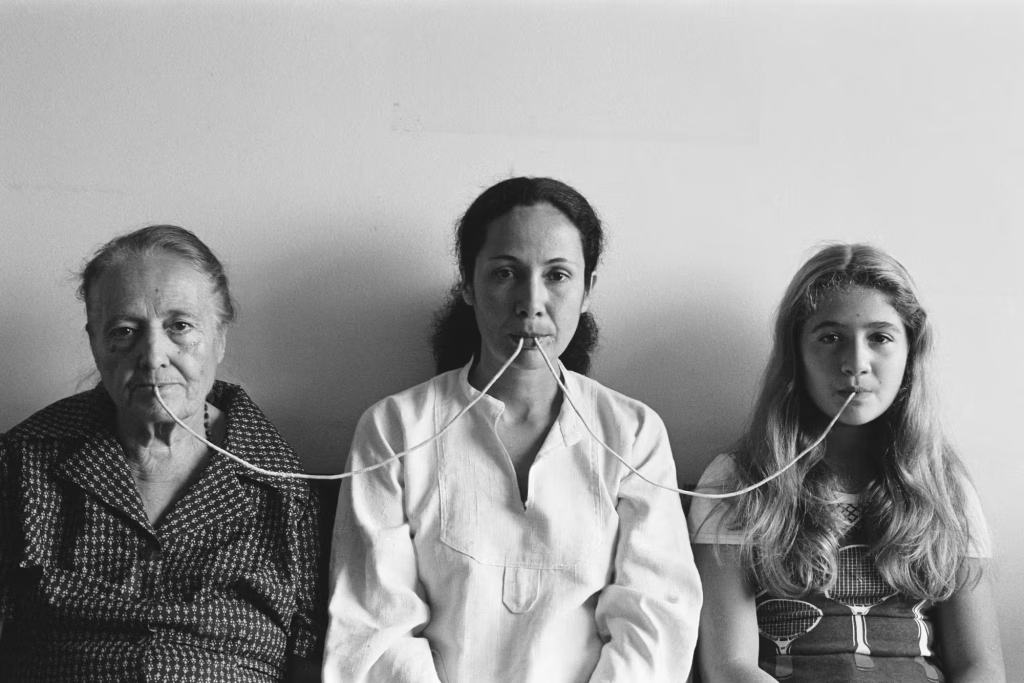
As a teenager, Maiolino emigrated with her family to Venezuela, and later settled in Brazil. These migrations placed her at the intersection of multiple languages, cultures, and political systems. Living between continents deeply influenced her sense of belonging and non-belonging, themes that would become central to her work.
In Brazil, she studied art and became part of an emerging generation of artists responding to the country’s military dictatorship. The political repression of the 1960s and 1970s forced many artists to find indirect, poetic ways of expressing dissent. Maiolino’s subtle yet powerful approach emerged from this environment, where silence often spoke louder than protest slogans.
Career Breakthrough and Key Milestones
Maiolino’s early artistic development coincided with Brazil’s experimental art movements, including New Figuration and Conceptualism. Rather than aligning fully with any single movement, she developed an independent voice rooted in personal experience and material exploration.
Her breakthrough came through works that combined drawing, sculpture, and performance, often using simple, repetitive gestures. Clay, paper, and organic materials became central to her practice. These materials allowed her to explore themes of labor, femininity, and impermanence without relying on overt political imagery.
Over time, her work gained international recognition through major exhibitions and retrospectives across Europe, Latin America, and North America. Despite working for decades, her global prominence expanded significantly later in her career, challenging the idea that cultural relevance is tied to youth or trend cycles.
Maiolino’s sustained practice demonstrates how artistic impact can deepen over time, especially when rooted in lived experience rather than market-driven innovation.
Cultural Impact and Global Influence
Anna Maria Maiolino’s cultural impact lies in her ability to transform personal history into universal language. Her work speaks to migration, exile, censorship, and the female body, issues that resonate across borders and generations.
She is particularly influential in conversations about feminist art, though she resists narrow labels. Rather than slogans, her feminism appears through process. Domestic gestures, repetitive labor, and bodily movement become acts of meaning. This approach has influenced generations of artists seeking to integrate identity without reducing it to symbolism.
Her global influence also reflects broader patterns explored in How culture spreads across borders in the internet age. Maiolino’s work circulates internationally not because it is easily digestible, but because it addresses shared human experiences in a fragmented world.
Museums increasingly position her within global modernism rather than regional art history, acknowledging her role in reshaping how contemporary art narratives are written.
Language, Silence, and the Politics of Expression
Language plays a central role in Maiolino’s work, particularly its limits. As a multilingual immigrant, she has often explored the frustration of expression and the gaps between words. Her art frequently replaces speech with action, repetition, and material presence.
This emphasis on silence and gesture feels especially relevant today. In an era dominated by constant communication, her work reminds audiences that meaning does not always require explanation. Sometimes, it resides in pause, pressure, and physicality.
Her approach aligns with broader cultural shifts discussed in Why cultural trends go global faster than ever, where depth and authenticity increasingly cut through digital noise.
Controversies, Criticism, and Public Interpretation
Maiolino’s work has occasionally challenged audiences unfamiliar with conceptual or performance-based art. Critics have sometimes questioned the accessibility of her minimalist gestures or the emotional intensity of her themes.
However, these debates often reinforce her importance. Her refusal to simplify meaning or conform to expectations positions her as an artist who trusts viewers to engage thoughtfully. Rather than controversy rooted in scandal, her work provokes intellectual and emotional reflection.
Over time, institutional recognition has reframed earlier misunderstandings, placing her work within a broader historical and political context.
Legacy and Why She Matters Today (2026 Perspective)
In 2026, Anna Maria Maiolino stands as a defining figure in contemporary global art. Her legacy is not confined to objects or exhibitions, but to ways of thinking about identity, labor, and resistance.
She represents an alternative model of influence, one built on consistency, ethical practice, and cultural memory. Her late-career recognition challenges ageism within creative industries and affirms the value of long-term artistic commitment.
As global audiences grapple with displacement, authoritarianism, and cultural fragmentation, her work feels increasingly urgent. She reminds us that art does not need to shout to be powerful.
Material, Repetition, and the Meaning of Labor
One of the most defining aspects of Anna Maria Maiolino’s practice is her relationship with labor. Her repeated gestures, rolling, pressing, kneading, cutting, and arranging materials, emphasize process over outcome. These acts mirror forms of domestic and bodily labor that have historically been undervalued or rendered invisible, particularly when performed by women.
By foregrounding repetition, Maiolino transforms routine action into meaning. The physical strain embedded in her work becomes a record of time, endurance, and care. Viewers are not just observing an object, they are encountering the trace of effort behind it. This approach resists the idea of art as effortless genius and instead frames creation as sustained commitment.
In a global culture increasingly obsessed with speed and instant results, her work offers a counterpoint. It invites audiences to slow down and acknowledge the value of persistence. This philosophy resonates strongly today, especially among younger generations questioning productivity culture and redefining success beyond constant output.
Migration, Belonging, and Fragmented Identity
Maiolino’s life across Italy, Venezuela, and Brazil deeply informs her exploration of identity. Rather than presenting migration as a single narrative of loss or assimilation, she treats it as an ongoing state of negotiation. Her work reflects the experience of existing between languages, cultures, and systems without fully settling into one.
This fragmented identity feels increasingly familiar in a globalized world where millions navigate hybrid cultural realities. Maiolino does not attempt to resolve this tension. Instead, she allows contradiction to exist, embracing uncertainty as a creative force.
Her refusal to present a fixed identity challenges traditional narratives of national or cultural purity. In doing so, she aligns with contemporary conversations around diaspora, transnational belonging, and cultural fluidity. This makes her work especially relevant in discussions about who gets to define culture in a global context.
Institutional Recognition and the Rewriting of Art History
For much of her career, Anna Maria Maiolino worked outside the central spotlight of Western art institutions. Her recent recognition reflects a broader effort within museums and curatorial practice to reassess overlooked voices and expand art historical narratives.
This reassessment is not simply about inclusion, but about correction. Maiolino’s work complicates linear histories of modern and contemporary art by showing how innovation also emerged from artists shaped by dictatorship, exile, and multilingual environments.
Her inclusion in major exhibitions has influenced how global modernism is taught and understood. Rather than positioning Europe and North America as the sole centers of artistic development, her career highlights the interconnected nature of artistic movements across continents.
This shift has long-term implications. It opens space for future generations of artists whose work exists between cultures, languages, and political systems.
Influence on Contemporary Thought Beyond Art
While Anna Maria Maiolino is primarily known as an artist, her influence extends into philosophy, feminist theory, and cultural studies. Scholars frequently reference her work in discussions about embodiment, silence, and the politics of care.
Her art encourages audiences to think beyond visual aesthetics and consider how meaning is constructed through action and presence. This has made her work particularly relevant in academic and interdisciplinary spaces where art intersects with social theory.
In an era where images circulate rapidly and context is often lost, Maiolino’s insistence on material engagement restores depth. She reminds viewers that culture is not only consumed, but lived and felt.
Why Her Work Continues to Resonate
Anna Maria Maiolino’s continued relevance lies in her refusal to simplify experience. Her work does not offer answers, but space. Space to reflect, to remember, and to recognize shared vulnerability.
As global societies confront displacement, political instability, and cultural fragmentation, her art feels less historical and more prophetic. It speaks quietly, but with endurance.
Her influence endures because it is rooted in humanity rather than spectacle. That is what makes her not only a contemporary art leader, but a lasting cultural figure.
Frequently Asked Questions
Who is Anna Maria Maiolino?
Anna Maria Maiolino is a contemporary artist known for her work in sculpture, drawing, performance, and installation, focusing on migration, feminism, and political memory.
What is Anna Maria Maiolino known for?
She is known for using simple materials and repetitive gestures to explore identity, language, and survival within global contemporary art.
Why is Anna Maria Maiolino important?
Her work reshaped feminist and conceptual art by integrating personal history with political awareness, influencing generations of artists worldwide.
What impact has Anna Maria Maiolino had on global culture?
She expanded contemporary art narratives beyond Eurocentric frameworks and highlighted migration, silence, and resilience as central cultural themes.
Anna Maria Maiolino’s biography is a story of movement, persistence, and quiet resistance. Her work bridges continents, histories, and generations without collapsing their complexity. In doing so, she offers a model of cultural influence rooted in care, memory, and material truth.
Her continued relevance proves that global impact is not measured by spectacle, but by the ability to speak honestly to shared human experience.
This biography is part of Loaded Culture’s ongoing exploration of global figures shaping identity, creativity, and influence. Discover more stories like this by visiting our Biography or explore the latest cultural analysis on our homepage, where global culture, history, and modern influence intersect.
