

In the internet age, culture no longer waits for permission to travel. A song recorded in a bedroom, a fashion silhouette born in a local market, or a slang phrase shaped by a specific neighborhood can cross continents in days. Understanding how culture spreads across borders in the internet age requires more than tracking viral moments; it means examining the systems, histories, and human desires that allow cultural ideas to move, mutate, and take root far from where they began.
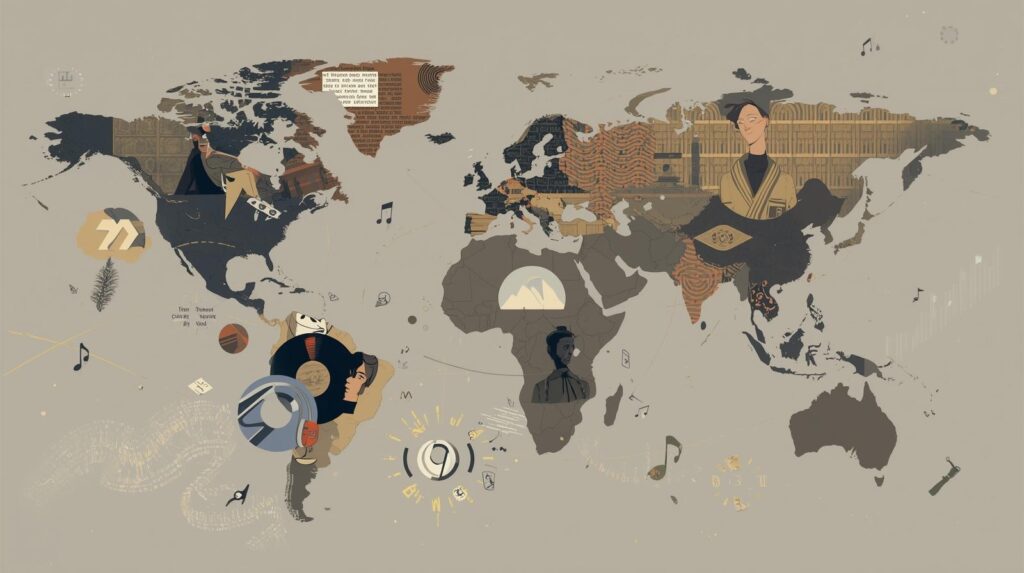
This is not a story of speed alone. It is a story of power, access, memory, and reinterpretation. Digital platforms have compressed distance, but they have not erased context. Instead, they have created a new cultural terrain—one where local expression can become global language, and where meaning is constantly negotiated between origin and audience.
Culture Before the Internet: Gateways and Gatekeepers
To understand the present, it helps to recall how culture once traveled. Before the internet, cultural exchange depended heavily on institutions: record labels, fashion houses, film studios, television networks, museums, and publishing industries. These gatekeepers decided what crossed borders and what remained local.
Music from Jamaica reached the world through vinyl exports and touring artists. Japanese street fashion entered Western consciousness through magazines and curated runway interpretations. Hip-hop culture spread globally via music videos, radio syndication, and later MTV—often stripped of its social and political context in the process.
This system was slow, hierarchical, and selective. Culture did spread, but unevenly. The internet did not invent global culture; it altered who controls its movement.
Platforms as Cultural Infrastructure
Today, social platforms function less like neutral stages and more like cultural infrastructure. TikTok, YouTube, Instagram, SoundCloud, Discord, and streaming services are not simply distribution tools; they actively shape which cultural expressions become visible.
Algorithms reward repetition, remixing, and emotional resonance. A dance challenge, a meme format, or a sound clip becomes a vessel that others can inhabit. Cultural forms are designed to be reused, not preserved in their original state.
Consider how Afrobeats evolved from regional West African scenes into a global sound. The genre’s spread was not driven by traditional industry exports alone, but by diasporic listeners sharing music online, dance clips circulating on social media, and collaborations that blurred geographic boundaries. The internet allowed Afrobeats to be heard not as “world music,” but as contemporary global pop—without losing its rhythmic identity.
Platforms make culture legible across borders, but they also flatten nuance. What travels best is often what can be easily replicated.
From Local Context to Global Language
One of the defining features of internet-age culture is its ability to detach from its original environment while still carrying traces of it. A local cultural expression becomes a global reference point once it enters a shared digital vocabulary.
Streetwear offers a clear example. What began as deeply local—rooted in skate culture, hip-hop communities, and specific urban geographies—has become a global uniform. Logos, silhouettes, and styling codes circulate freely, worn by youth in cities with entirely different social realities.
Yet this is not simple imitation. Local audiences reinterpret what they receive. Korean street style draws from American hip-hop but filters it through local aesthetics and social norms. Nigerian youth remix luxury fashion with traditional textiles. Brazilian funk culture borrows global pop structures while maintaining rhythms tied to specific neighborhoods.
Culture spreads by translation, not duplication.
The Role of Youth as Cultural Carriers
Young people are the primary agents of cultural movement in the internet age. This is not only because they are digitally fluent, but because youth culture has always been experimental, adaptive, and outward-looking.
Online, young users learn culture socially. They do not wait for official explanations; they absorb through participation—by watching, copying, remixing, and responding. Identity formation happens in public, through shared references that cross borders effortlessly.
Internet subcultures—whether centered on music genres, fashion aesthetics, gaming communities, or niche humor—often feel borderless. A teenager in Nairobi and one in Berlin can share the same visual language, musical influences, and internet slang while living vastly different offline lives.
This does not erase difference. It creates layered identity, where global culture overlays local experience.
How Culture Spreads Across Borders in the Internet Age: Speed vs Meaning
The speed of cultural circulation today often obscures a deeper question: what happens to meaning as culture travels faster?
A meme originating from a specific political or social moment can become pure entertainment once removed from its context. Dance styles rooted in communal rituals or resistance can be reduced to aesthetic gestures. Language shaped by survival or marginalization can become trend language.
This is where tension emerges. Cultural spread is not inherently harmful, but it raises questions about recognition, attribution, and respect. Who benefits when culture goes global? Who is visible, and who remains invisible?
The internet amplifies voices, but it also rewards those who already have access to attention. Cultural origins can be obscured not by malice, but by scale.
Diaspora as a Cultural Bridge
Diaspora communities play a crucial role in how culture moves across borders online. They act as translators, connectors, and amplifiers—maintaining ties to cultural roots while navigating new environments.
Afrobeats offers a clear case study of how culture spreads across borders in the internet age. What began as a regional sound shaped by Nigerian and Ghanaian youth has become a global cultural language through streaming platforms, social media, and diasporic circulation. Artists do not simply export music; they carry visual, linguistic, and historical references that travel alongside the sound.
Davido’s recent appearance in Sierra Leone, where his outfit drew directly from local cultural identity, illustrates how Afrobeats now operates as a connective tissue across African cultures rather than a one-directional export. The moment reflects how contemporary African artists use visibility to acknowledge shared histories and regional influence, reinforcing cultural exchange rather than hierarchy.
Through diaspora, culture does not simply leave home; it circulates. Music, food, language, and fashion are shared back and forth, shaped by migration and memory. Internet platforms allow diasporic communities to remain culturally active rather than culturally nostalgic.
Latin American music’s global rise, for example, is inseparable from diaspora audiences who consumed, shared, and reshaped it abroad. Reggaeton, once dismissed as regional, gained international power through transnational networks long before mainstream recognition followed.
Diaspora-driven cultural spread is not about loss. It is about continuity under new conditions.
Internet Culture and the Politics of Visibility
Visibility is the currency of the internet age. Cultural forms that align with platform aesthetics—short-form video, visual clarity, repeatable formats—are more likely to spread. This shapes not only what culture travels, but how it is expressed.
Music production adapts to streaming algorithms. Fashion adapts to camera framing. Language adapts to caption limits. Even identity becomes optimized for legibility.
This does not mean culture becomes inauthentic, but it does mean expression is strategic. Creators learn how to package culture in ways that travel.
At the same time, marginalized cultures often gain visibility through platforms that bypass traditional institutions. Internet distribution has allowed underground scenes, independent artists, and local movements to reach audiences that were previously inaccessible.
Cultural power is no longer centralized—but it is still uneven.
Remix Culture and Collective Ownership
One of the most profound shifts of the internet age is the normalization of remixing. Culture now spreads through reinterpretation rather than preservation.
A song becomes a sound clip. A fashion trend becomes a template. A phrase becomes a meme. Ownership becomes diffuse, and authorship becomes collaborative.
This challenges older ideas of cultural purity. Instead of asking whether a cultural form is being “kept intact,” the internet asks whether it is alive enough to be reused.
Remix culture reflects a broader truth: culture survives by being flexible. What matters is not that meaning remains fixed, but that it remains connected to human experience.
Global Culture, Unequal Ground
Despite its borderless appearance, internet culture exists within global inequalities. Access to technology, language dominance, and economic power all influence whose culture travels most easily.
English remains the dominant digital language. Western platforms still shape global visibility. Creators from the Global South often gain recognition only after validation by Western audiences.
Understanding how culture spreads across borders in the internet age means acknowledging these imbalances without reducing cultural exchange to exploitation alone. The reality is more complex: agency and constraint exist simultaneously.
Culture as a Living System
Culture is not a product that moves from one place to another unchanged. It is a living system that responds to new environments. The internet has not flattened culture into sameness; it has multiplied points of contact.
Local culture becomes global reference. Global culture becomes local material. Meaning is constantly renegotiated.
What we are witnessing is not cultural dilution, but cultural acceleration—with all its contradictions.
A World Connected by Expression
The internet age has revealed something fundamental: people everywhere want to be seen, heard, and understood. Culture spreads across borders not because platforms exist, but because humans recognize themselves in each other’s expression.
The challenge now is not whether culture will travel—it will—but whether we learn to trace its roots, respect its origins, and remain attentive to the lives behind the trends.
In a world where culture moves faster than ever, depth becomes a choice. Those who choose to look beyond the surface will find not a global monoculture, but a dense, shifting map of shared creativity—still grounded in place, even as it moves across the world.
