

When it felt like the world was quietly agreeing that Wizkid mattered more than Fela Kuti
For a split second, the timeline made it look clean: Wizkid fighting for African artists to be seen, to be honoured properly, to stop being pushed to the corners of global ceremonies, while Fela, the man whose spirit lives inside the very DNA of Afrobeat, gets a “Lifetime Achievement” moment off the main stage and before the main Grammy night. It looked like history being politely acknowledged… and quietly filed away. And if you’re African, if you understand what culture means beyond applause, you can’t shake the feeling: is the world trying to celebrate our legends without ever truly centering them?
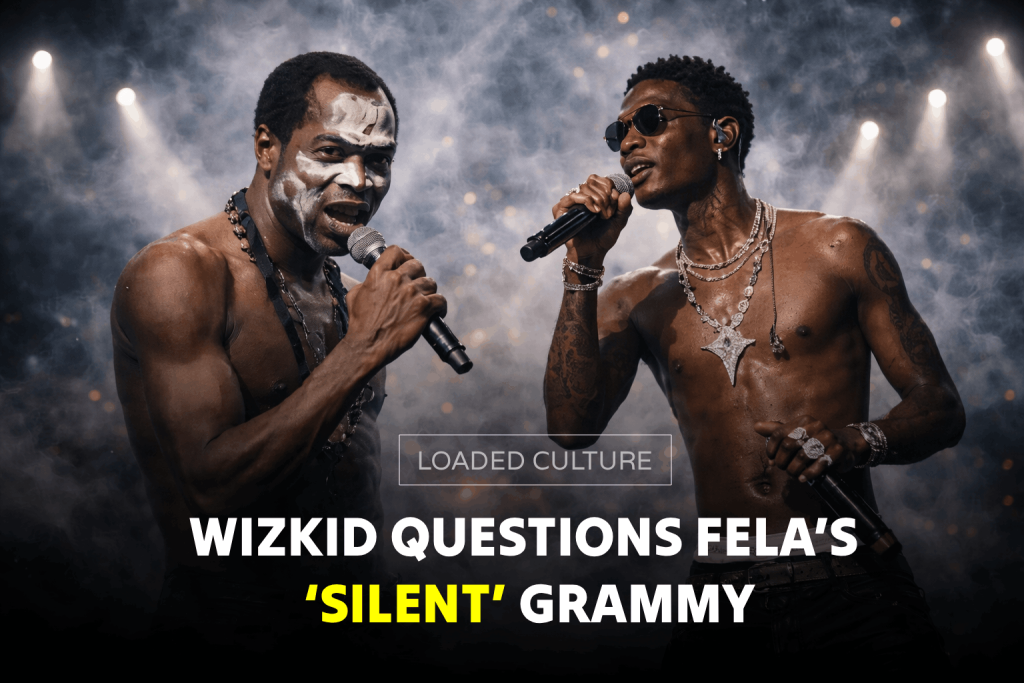
But to understand why this hit people so hard, we have to step away from fan wars and step into something colder: how global recognition is staged, controlled, and distributed, especially when Africa is involved.
The real controversy isn’t the award. It’s the placement.
Fela receiving a Lifetime Achievement Grammy is a major moment. The Recording Academy’s Lifetime Achievement Award is one of its highest honours, and multiple outlets reported that Fela was among the 2026 recipients.
The problem is what many people only notice after the shock: these Lifetime Achievement honours are presented at the Special Merit Awards ceremony, which happens before the televised Grammys. For 2026, that ceremony took place on January 31, 2026, the day before the main Grammy broadcast on February 1, 2026.
So yes, Fela’s award being pre-ceremony fits Grammy tradition.
And that’s exactly why Africans are upset.
Because tradition can still carry a message.
If the world’s biggest music institution habitually places certain honours outside the main spotlight, then the argument becomes bigger than Fela: who gets the prime-time story, and who gets the footnote?
Why this stung harder than usual
Fela isn’t just “another influential artist.” He’s not a nostalgia act. He’s a political language. A cultural architecture. A blueprint for resistance and sound.
When a figure like that is honoured in a room that many everyday viewers will never watch, it creates a familiar African feeling:
“We’re respected… but not centered.”
And you don’t have to believe in conspiracies to feel it. Culture is emotional. People don’t experience respect as a PDF document; they experience it as visibility.
This is why the phrase “silent award” caught fire online. Not because the ceremony was literally silent—but because, in the global attention economy, anything outside the main stage can feel like a whisper.
The Wizkid factor: why his protest hits the nerve
Wizkid didn’t invent this frustration, he’s just a modern face for it.
The broader context is that African artists and fans have long complained about being treated like guests in global pop culture: invited to perform, invited to trend, invited to generate streams… yet still fighting for equal presentation when the trophies come out.
That “backstage awards” theme has circulated for years in entertainment conversations, especially around international events and how non-Western winners are handled.
So when Wizkid frames the issue as dignity and visibility, he’s tapping into something bigger than himself: the right to be celebrated properly, in the same light as everyone else.
Then Seun Kuti entered the chat, and the debate became a family wound
The moment the internet started doing what it always does, turning a structural issue into a personality contest, the conversation slid into a dangerous place: “Who is bigger?”
That’s when Seun Kuti pushed back hard against comparisons between Wizkid and Fela, arguing that such debates flatten legacy into popularity and ignore what Fela represented beyond music.
And this is where the story gets uncomfortable, because both sides are reacting to something real:
-
Wizkid’s side is reacting to how Africa is treated now.
-
Seun’s side is reacting to how history is being rewritten.
One is fighting for stage placement today.
The other is fighting to stop legacy from being reduced to numbers.
The trap: when fanbases confuse influence with importance
The internet is obsessed with measurable greatness:
-
streams
-
awards
-
stadiums
-
charts
-
“who’s bigger?”
But cultural greatness doesn’t always behave like a scoreboard.
Fela’s influence isn’t just about sound, it’s about the idea that music can be a weapon against power. That kind of influence doesn’t trend the same way, and it doesn’t fit neatly into “versus” debates.
So when fanbases force a comparison between artists from different eras, it creates a false conclusion: that the present automatically outranks the past.
Seun’s anger is partly about that distortion.
The truth nobody wants to say: the Grammys didn’t single out Fela, yet Africa still has a point
Here’s the most honest version of this story:
-
The Grammys presenting Lifetime Achievement awards outside the main broadcast is normal.
-
But Africans are right to ask why “normal” often still feels like being kept at the edge of the light, especially when African music is globally consumed and profitable.
Both things can be true.
Africa can be grateful and still demand parity.
Because gratitude without critique is how imbalance becomes permanent.
What real respect would look like
If the global industry truly wants to honour African culture (not just borrow it), respect has to become structural:
-
Prime-time visibility for African milestones
-
Proper storytelling that explains why pioneers matter
-
More African decision-makers and curators in global institutions
-
Fewer “side-room” moments for history-shaping legacies
Not because Africa needs charity, because Africa has earned equivalence.
This was never Wizkid vs Fela
This is the part fans may hate, but culture needs:
This was never truly about who is “greater.”
It’s about a pattern, one that keeps showing up in different outfits:
-
Backstage vs main stage
-
Pre-ceremony vs prime-time
-
“We honour you” vs “we center you”
And until African excellence is centered the same way it is consumed, these moments will keep triggering the same feeling, like the world is applauding Africa with one hand while keeping the spotlight with the other.
