

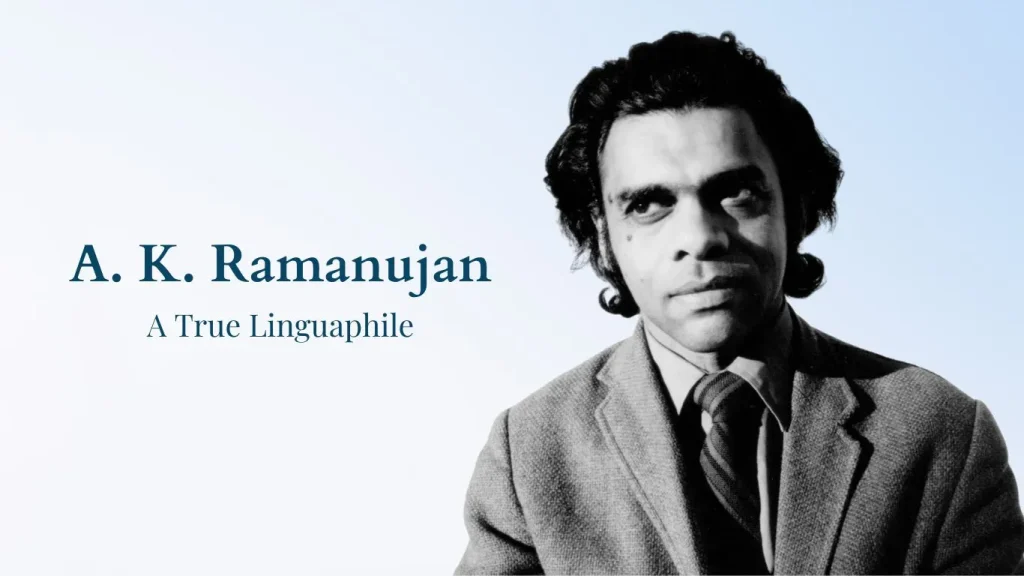
A. K. Ramanujan was one of the most important Indian literary figures of the 20th century – a poet, translator, folklorist, and scholar whose work reshaped how Indian literature was read both in India and abroad. Known for writing in English and Kannada, and for translating classical Tamil poetry, Ramanujan built bridges between ancient tradition and modern expression.
His writing combined intimacy, intellectual depth, cultural memory, and sharp observation. Today, he remains central to conversations about postcolonial literature, Indian identity, translation studies, and global poetry.
Early Life and Education
Attipate Krishnaswami Ramanujan was born on March 16, 1929, in Mysore, in what is now Karnataka, India. He grew up in a multilingual and intellectually vibrant household. His father was a mathematician and astronomer, and his family environment encouraged deep curiosity and academic discipline.
Ramanujan grew up speaking Kannada at home, learning Tamil from his relatives, and studying English in school. This multilingual upbringing would later define his literary career. Unlike many writers who work within a single linguistic tradition, Ramanujan navigated between languages with unusual fluency and cultural sensitivity.
He completed his undergraduate and master’s degrees at the University of Mysore. Later, he moved to the United States, where he earned a PhD in linguistics from Indiana University in 1963. His academic training in linguistics shaped his analytical approach to literature, folklore, and translation.
Career in the United States
After completing his doctorate, Ramanujan joined the University of Chicago, where he became a professor in the Departments of South Asian Languages and Civilizations, Linguistics, and Comparative Literature. His career in the U.S. positioned him as a key interpreter of Indian literary traditions for Western audiences.
At a time when Indian literature was often narrowly understood through colonial or exotic lenses, Ramanujan offered a nuanced, scholarly, and deeply personal interpretation of Indian texts. He showed that Indian traditions were complex, layered, and intellectually sophisticated.
His academic influence extended across disciplines – literature, anthropology, folklore studies, linguistics, and religious studies. Students and scholars alike admired his ability to combine poetic sensitivity with rigorous scholarship.
Poetry: Personal, Cultural, Modern
Ramanujan wrote poetry primarily in English, though he also wrote in Kannada. His English poetry is known for its clarity, irony, emotional restraint, and quiet intensity.
Some of his most famous poetry collections include:
-
The Striders (1966)
-
Relations (1971)
-
Second Sight (1986)
-
The Black Hen (posthumously published, 1995)
His poems often explored themes such as:
-
Family relationships
-
Memory and childhood
-
Migration and displacement
-
Cultural duality
-
The tension between tradition and modernity
One of his most widely anthologized poems, “Self-Portrait,” reflects on identity and perception. Another, “Obituary,” examines the legacy of a father through a lens that is both affectionate and ironic.
Ramanujan’s poetry does not rely on grand declarations. Instead, it works through subtle detail, domestic scenes, and reflective observation. His voice feels intimate yet intellectually precise, making his work enduringly relevant.
Master of Translation
Beyond poetry, Ramanujan is internationally respected for his translations of classical Indian texts. He translated ancient Tamil Sangam poetry into English in The Interior Landscape (1967), a landmark publication that introduced global audiences to early Tamil literature.
He later translated Kannada vacana poetry in Speaking of Siva (1973), which won the U.S. National Book Award for Translation in 1974. This recognition brought rare global attention to medieval Indian devotional poetry.
Ramanujan’s translations were not literal word-for-word renderings. Instead, he aimed to capture tone, cultural nuance, emotional texture, and poetic rhythm. He believed translation required both linguistic accuracy and creative re-imagination.
His work helped reposition Indian classical literature within global literary discourse, ensuring it was not seen as archaic or inaccessible, but as vibrant and emotionally powerful.
Folklore and Cultural Scholarship
Ramanujan’s intellectual curiosity extended to folklore and oral traditions. His essay collection Folktales from India and his research into oral narratives demonstrated his belief that culture is dynamic, layered, and constantly evolving.
One of his most debated essays, “Three Hundred Ramayanas,” explored the many versions of the Ramayana across different regions, languages, and traditions. The essay sparked controversy in India years after his death, particularly when it was removed from university curricula due to political pressure.
The debate surrounding the essay reflected Ramanujan’s larger impact – he challenged simplified or singular views of tradition. He showed that Indian culture is plural, diverse, and historically fluid.
Themes of Identity and Diaspora
As an Indian scholar living in America, Ramanujan often reflected on displacement and cultural negotiation. His work quietly captures what it means to belong to more than one world.
Unlike overtly political writers, Ramanujan’s engagement with identity was subtle. He examined how memory, language, and family shape personal identity. His poetry often returns to India through recollection, but filtered through distance.
In this way, he became an early voice in what would later be widely discussed as diaspora literature. His writing speaks to global readers navigating migration, hybridity, and cultural complexity.
Literary Style and Influence
Ramanujan’s style is marked by:
-
Economy of language
-
Sharp imagery
-
Emotional restraint
-
Intellectual depth
-
Cross-cultural awareness
He avoided rhetorical excess. His poems feel carefully constructed, almost architectural in precision. Yet beneath that structure lies emotional vulnerability.
He influenced generations of Indian English poets and scholars. Writers such as Vikram Seth, Arvind Krishna Mehrotra, and later diasporic poets have acknowledged the importance of his model – rooted in Indian tradition, yet globally engaged.
In academic circles, his work remains central to translation studies and comparative literature.
Awards and Recognition
Throughout his career, Ramanujan received numerous honors, including:
-
Sahitya Akademi Award
-
National Book Award for Translation
-
MacArthur Fellowship nomination recognition
-
Fellowship of the American Academy of Arts and Sciences
These accolades reflected both his creative and scholarly achievements.
Death and Legacy
A. K. Ramanujan passed away on July 13, 1993, in Chicago. His death was widely mourned in both India and the United States.
Today, his legacy remains deeply influential. His poetry continues to be studied in schools and universities. His translations remain foundational texts for understanding Indian classical literature. His essays continue to provoke discussion about pluralism and cultural interpretation.
More importantly, Ramanujan demonstrated that literature can act as a bridge – between languages, between continents, and between past and present.
Why A. K. Ramanujan Still Matters
In an era when discussions about identity, tradition, and globalization dominate cultural conversations, Ramanujan’s work feels remarkably contemporary.
He showed that tradition is not rigid.
He showed that identity is layered.
He showed that translation is creative transformation.
His life represents a model of intellectual openness – rooted in heritage, yet outward-looking.
For readers exploring global literature, postcolonial studies, or cross-cultural identity, A. K. Ramanujan remains essential.
Ramanujan’s Approach to Language and Multilingual Identity
One of the most remarkable aspects of A. K. Ramanujan’s life and work was his comfort across languages. He did not treat languages as separate compartments but as overlapping cultural systems that shaped one another. Kannada, Tamil, and English were not simply tools for communication – they were different emotional and intellectual worlds.
This multilingual sensitivity gave his poetry a unique texture. Even when writing in English, his lines often carried rhythms, images, and cultural references drawn from South Indian traditions. His poems sometimes feel like translations of lived experience rather than direct English compositions, which gives them a layered quality.
Ramanujan once described himself as having “multiple inheritances.” That phrase captures his broader literary philosophy. He believed identity was not singular or fixed, but composite and evolving. His ability to inhabit more than one linguistic world without abandoning any of them made him a rare literary figure in postcolonial literature.
The Interior Landscape and Classical Tamil Poetry
When The Interior Landscape was published in 1967, it transformed how classical Tamil Sangam poetry was viewed internationally. These ancient poems, written between roughly 300 BCE and 300 CE, explore love, separation, war, and nature with striking emotional intensity.
Before Ramanujan’s translations, these texts were largely unknown to Western audiences. His work made them accessible without stripping them of cultural nuance. He preserved the poetic structure while explaining the symbolic geography central to Sangam literature, where landscapes represent emotional states.
For example, mountains, forests, and seashores were not merely physical settings but coded emotional terrains connected to love and longing. Ramanujan’s scholarly introductions helped readers understand these cultural frameworks, allowing the poems to resonate beyond their original context.
His translations demonstrated that ancient Indian poetry could stand alongside Greek, Chinese, or Persian classics in global literary discussions.
Three Hundred Ramayanas and Intellectual Courage
Perhaps one of Ramanujan’s most influential essays was “Three Hundred Ramayanas: Five Examples and Three Thoughts on Translation.” In it, he argued that the Ramayana tradition does not exist as a single authoritative narrative, but as hundreds of regional and linguistic variations across South and Southeast Asia.
He showed that storytelling traditions adapt across time and culture, reflecting local values and historical contexts. This interpretation challenged rigid views that treat sacred narratives as singular and unchanging.
Years after his death, the essay became the center of academic controversy in India when it was removed from a university syllabus following political protests. The debate highlighted the enduring power of Ramanujan’s scholarship. His work did not seek to diminish tradition but to expand understanding of its diversity.
This episode also reinforced his legacy as a scholar unafraid to explore complexity.
Influence on Comparative Literature
Ramanujan’s contribution to comparative literature cannot be overstated. He encouraged scholars to examine texts not in isolation, but in conversation with one another across cultures.
At the University of Chicago, he helped build strong South Asian studies programs and influenced how Indian texts were taught in Western academia. He insisted that translation should not flatten cultural difference, but illuminate it.
His interdisciplinary method – combining linguistics, anthropology, folklore, and literary analysis – remains influential today. Scholars continue to cite his frameworks when studying narrative traditions, oral storytelling, and diaspora writing.
A Quiet but Lasting Cultural Impact
Unlike some literary figures who achieve fame through public controversy or dramatic self-presentation, Ramanujan’s influence was quiet but enduring. His writing is thoughtful rather than provocative, analytical rather than sensational.
Yet that restraint is precisely what makes his work powerful. He approached culture with patience and respect. He treated poetry as both art and inquiry.
In many ways, Ramanujan helped global readers understand that Indian literature is not monolithic. It contains multiplicities – of language, of belief, of storytelling styles. His scholarship contributed to a broader understanding of how culture spreads, adapts, and transforms across borders.
Conclusion: A Bridge Between Worlds
A. K. Ramanujan stands as one of the most important literary mediators of the modern era. He was not just a poet or translator. He was a bridge-builder between ancient and modern, India and America, scholarship and creativity.
His work reminds readers that identity is layered, that tradition is plural, and that translation is an act of imagination as much as precision.
Decades after his passing, his poems are still read, his translations still studied, and his essays still debated. That continued relevance is the clearest sign of lasting literary influence.
A. K. Ramanujan’s life proves that literature can cross languages, cultures, and generations – quietly shaping how the world understands itself.
Frequently Asked Questions (FAQ)
Who was A. K. Ramanujan?
A. K. Ramanujan was an Indian poet, translator, folklorist, and scholar known for his contributions to English poetry and the translation of classical Tamil and Kannada literature. He played a major role in introducing Indian literary traditions to global audiences.
When and where was A. K. Ramanujan born?
He was born on March 16, 1929, in Mysore, India. He later moved to the United States, where he built much of his academic career.
What is A. K. Ramanujan famous for?
Ramanujan is best known for his English poetry collections such as The Striders and Relations, as well as his translations of classical works like The Interior Landscape and Speaking of Siva. He is also widely recognized for his essay “Three Hundred Ramayanas.”
What languages did A. K. Ramanujan write in?
He wrote poetry in English and Kannada, and he translated from Tamil and Kannada into English. His multilingual background strongly influenced his literary style and scholarly approach.
Why is “Three Hundred Ramayanas” important?
The essay highlights the existence of multiple versions of the Ramayana across different cultures and regions. It challenged the idea of a single authoritative narrative and emphasized the diversity within Indian storytelling traditions.
What awards did A. K. Ramanujan receive?
He received several prestigious honors, including the Sahitya Akademi Award and the U.S. National Book Award for Translation for Speaking of Siva. He was also a respected professor at the University of Chicago.
How did A. K. Ramanujan influence modern literature?
Ramanujan influenced generations of poets, translators, and scholars by showing how literature can bridge cultures. His work shaped discussions in postcolonial studies, translation theory, comparative literature, and diaspora identity.
When did A. K. Ramanujan die?
He passed away on July 13, 1993, in Chicago, United States. His literary and academic legacy continues to shape global literary studies.
This biography is part of Loaded Culture’s exploration of global figures shaping identity, leadership, and cultural evolution. Discover more profiles in our Biography category or explore broader cultural analysis on the LoadedCulture. where history, influence, and modern culture connect.
